
By: Dr. Pranab Kr. Das, Assistant Professor, Department of Geography, Sree Chaitanya College, Habra

Concept of Society:
In social studies’ Society’ is the most fundamental to understand. Human societies are characterized by patterns of relationships (social relations) between individuals who share a distinctive culture and institutions. A society may be described as the sum total of such relationships among its members. Often, society is an organization of people who share a common cultural and social background. For example, the Brahmo Samaj, Arya Samaj, etc. It is very difficult to define society as it has various dimensions and aspects.
As per Cambridge dictionary “a large group of people who live together in an organized way making decisions about how to do things and sharing the work that needs to be done, the group is called society.”
In social geography, society can be defined as “a group of people, who share a common Socio-economic, political or spiritual environment or infrastructure”. Human society is a group of people involved with each other through specific relations or a large social group sharing the same geographical or social territory, typically subject to the same political authority and dominant cultural expectations.
A society may be restricted for a particular ethnic group, such as Bhutan is the land for Bhutanese; in Bengali Association of London, majority of the members are migrated from West Bengal, or Anglo-Indians of Kolkata. This type of society is very much conscious about their purity as they are minority in their localities. It is noticed that the societies of the minorities are functioned by ethnicity.
However, a larger society is often classified into subgroups based on different ethnicity, origin, demography, activities and needs. For example; in a cultural society, the activities and needs may be varied in various age groups and the age groups may act as sub-groups. Or, a professional organization or society which has members from different states may be sub-grouped based on members origin.
The word society may also refer to an organized voluntary association of people for religious, benevolent, cultural, scientific, political, patriotic, or other purposes. Member of this organizations or society may be formed with different ethnic, religious, linguistic or political groups and it only focused on its functions. For, example; in teachers or student organizations; anybody can be part of these organizations if they either teacher or students. More broadly, a society may be illustrated as an economic, social, or industrial infrastructure, made up of a varied collection of individuals.
Types of Societies
Humans have established many types of societies throughout the history. Virtually all societies have developed some degree of inequality among their people through the process of social stratification, the division of members of a society into levels with unequal wealth, prestige, or power. Social scientists place societies in three broad categories: Pre-industrial, Industrial and Post-industrial.
Hunting and Gathering:

The members of hunting and gathering societies primarily survive by hunting animals, fishing, and gathering plants and parts of plants. The vast majority of these societies existed in the past, with only a few (perhaps a million people total) living today on the verge of extinction in tropical rainforests of Asia, Africa and South America. Such as Jarwa of Andaman, Seringueiros tribe of Amazon , Bantu of Kongo, Korowai of Indonesia.
To survive, early human societies completely depended upon their immediate environment. When the animals left the area, the plants died, or the rivers dried up, the society had to relocate to an area where resources were plentiful. Consequently, hunting and gathering societies, which were typically small, were quite mobile. In some cases, where resources in a locale were extraordinarily plentiful, small villages might form. But most hunting and gathering societies were nomadic, moving constantly in search of food and water. Labor in hunting and gathering societies was divided equally among members. Because of the mobile nature of the society, these societies stored little in the form of surplus goods. Therefore, anyone who could hunt, fish, or gather fruits and vegetables did so. These societies probably also had at least some division of labor based on gender. Males probably traveled long distances to hunt and capture larger animals. Females hunted smaller animals, gathered plants, made clothing, protected and raised children, and helped the males to protect the community from rival groups.Hunting and gathering societies were also tribal. Members shared an ancestral heritage and a common set of traditions and rituals. They also sacrificed their individuality for the sake of the larger tribal culture.
Pastoral societies:
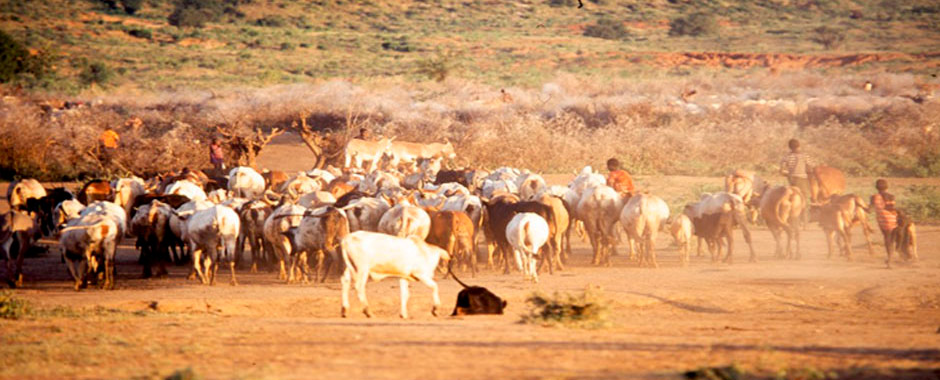
Members of pastoral societies, which first emerged 12,000 years ago, pasture animals for food and transportation. Pastoral societies still exist today, primarily in the desert lands of North Africa where horticulture and manufacturing are not possible. Domesticating animals allows for a more manageable food supply than do hunting and gathering. Hence, pastoral societies are able to produce a surplus of goods, which makes storing food for future use a possibility. With storage comes the desire to develop settlements that permit the society to remain in a single place for longer periods of time. And with stability comes the trade of surplus goods between neighboring pastoral communities. Pastoral societies allow certain of its members (those who are not domesticating animals) to engage in non-survival activities. Traders, healers, spiritual leaders, craftspeople, and people with other specialty professions appear. Pastoral society is still exists Tibet, Mongolia among the various nomadic tribes.
Horticultural societies:
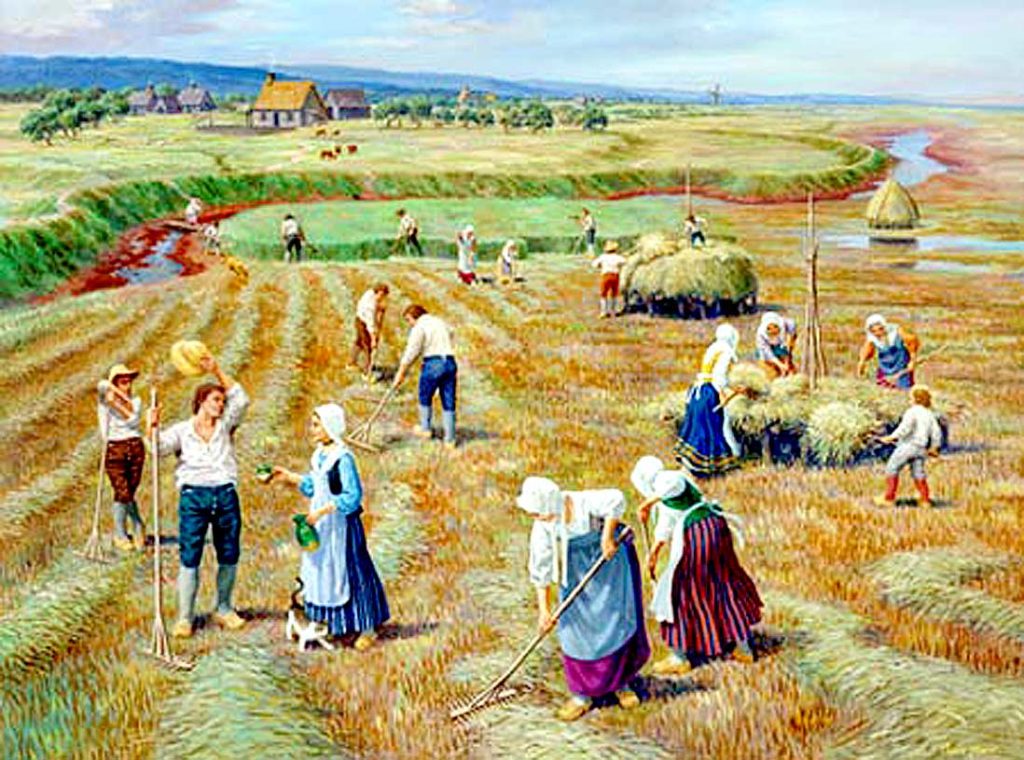
Unlike pastoral societies that rely on domesticating animals, horticultural societies rely on cultivating fruits, vegetables, and plants. These societies first appeared in different parts of the planet about the same time as pastoral societies. Like hunting and gathering societies, horticultural societies had to be mobile. Depletion of the land’s resources or dwindling water supplies, for example, forced the people to leave. Horticultural societies occasionally produced a surplus, which permitted storage as well as the emergence of other professions not related to the survival of the society. Still horticultural society exists in various vineyards of Meditation climatic regions.
Agrarian Societies:

Agricultural societies use technological advances to cultivate crops (especially grains like wheat, rice, corn, and barley) over a large area. Social scientists use the phrase Agricultural Revolution to refer to the technological changes that occurred as long as 8,500 years ago that led to cultivating crops and raising farm animals. Increases in food supplies then led to larger populations than in earlier communities. This meant a greater surplus, which resulted in towns that became centers of trade supporting various rulers, educators, craftspeople, merchants, and religious leaders who did not have to worry about locating nourishment.
Greater degrees of social stratification appeared in agricultural societies. For example, women previously had higher social status because they shared labor more equally with men. In hunting and gathering societies, women even gathered more food than men. But as food stores improved and women took on lesser roles in providing food for the family, they became more subordinate to men.
As villages and towns expanded into neighboring areas, conflicts with other communities inevitably occurred. Farmers provided warriors with food in exchange for protection against invasion by enemies. A system of rulers with high social status also appeared. This nobility organized warriors to protect the society from invasion. In this way, the nobility managed to extract goods from the “lesser” persons of society. Still, majority of the global population (60%) associated with agrarian society, mostly in Monsoon Asia, East Asia, Africa, Latin America and Oceania.
Feudal Societies:
From the 9th to 15th centuries, feudalism was a form of society based on ownership of land. Unlike today’s farmers, vassals under feudalism were bound to cultivating their lord’s land. In exchange for military protection, the lords exploited the peasants into providing food, crops, crafts, homage, and other services to the owner of the land. The caste system of feudalism was often multi-generational; the families of peasants may have cultivated their lord’s land for generations. Between the 14th and 16th centuries, a new economic system emerged that began to replace feudalism. Capitalism is marked by open competition in a free market, in which the means of production are privately owned. Europe’s exploration of the Americas served as one impetus for the development of capitalism. The introduction of foreign metals, silks, and spices stimulated great commercial activity in Europe. In south Asia feudalism was evolved by the colonial powers. India, the land-lord or Jamindars captured the rural economy. They were directly not engaged with agriculture but used to get majority share of it. There were various movements in different countries against the feudalism such as French Revolution in France, Bolshevik Revolution in Russia, and the American Civil war. In India there were also such movements for examples, Indigo revolt, Santhal and Kol revolt etc.
Industrial societies:

Industrial societies are based on using machines (particularly fuel‐driven ones) to produce goods. Social scientists refer to the period during the 18th century when the production of goods in mechanized factories began as the Industrial Revolution. The Industrial Revolution appeared first in Britain, and then quickly spread to the rest of the world through different countries of west Europe.
As productivity increased, means of transportation improved to better facilitate the transfer of products from place to place. Great wealth was attained by the few who owned factories, and the “masses” found jobs working in the factories.
Industrialization brought about changes in almost every aspect of society. As factories became the center of work, “home cottages” as the usual workplace became less prevalent, as did the family’s role in providing vocational training and education. Public education via schools and eventually the mass media became the norm. People’s life expectancy increased as their health improved. Political institutions changed into modern models of governance. Cultural diversity increased, as did social mobility. Large cities emerged as places to find jobs in factories.
Social power moved into the hands of business elites and governmental officials, leading to struggles between industrialists and workers. Labor unions and welfare organizations formed in response to these disputes and concerns over workers’ welfare, including children who toiled in factories. Rapid changes in industrial technology also continued, especially the production of larger machines and faster means of transportation. The Industrial Revolution also saw to the development of bureaucratic forms of organization, complete with written rules, job descriptions, impersonal positions, and hierarchical methods of management. The fundamental change caused by the Industrial Revolution is emergence of ‘Middle Class’ from labour class. Initially, the owners of the factories were from feudal societies. The economic and social disparities among labourers created class struggle. The class struggles did various social reformations. Nowadays, the industrial society presence in almost every developed and developing nations of the world.
Postindustrial societies:

With development of computer, software and IT revolution, the world is witnessing a technological threshold to next level. This revolution is creating a postindustrial society based on information, knowledge, and the selling of services. Now, economy is based in service sector which run by talented educated persons. Society is being shaped by the human mind, aided by computer technology. Although factories will always exist, the key to wealth and power seems to lie in the ability to generate, store, manipulate, and sell information through algorithm and artificial intelligence.
Social scientists predict increased levels of education and training will enhance a section of a society. But this technological based society may increase the disparities. The unprivileged section of the society cannot afford the high-tech skill and they lag behind. However, it is believe that as the members of post-industrial society are more educated and conscious the social conflict will less as everyone works together to solve society’s problems through science.
 Geo-Synthesis