
By: Dr. Pranab Kr. Das, Assistant Professor, Department of Geography, Sree Chaitanya College, Habra
Introduction:
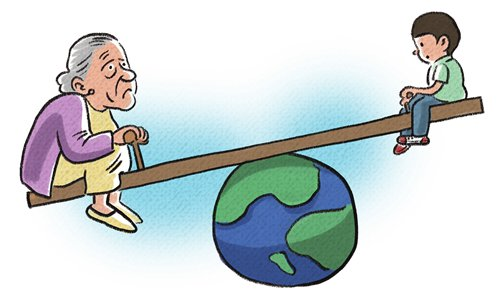
Many developed nations are dealing with the challenges of an aging population, particularly in North America, Western Europe, and Japan. As people live longer and birth rates decline, policymakers face issues like a shrinking working-age population, rising healthcare expenses, unmanageable pension commitments, and shifts in economic demands. These problems have the potential to seriously impact the comfortable living standards found in many advanced economies.
What is population ageing?
An aging population is an increase in the number of older people within a population, whilst the number of young people remains low or does not increase. It’s the result of the interplay of longer lives and fertility decline. Its part of a long-term development called the demographic transition, which leads from a regime of high mortality and high fertility to one with low mortality and low fertility. As the large generations born during the time of high fertility are living longer, and the subsequent generations born at the time of fertility decline are smaller, the population as a whole is ageing. All countries experience this process sooner or later. The most frequently used indicators to demonstrate this are the percentage of people above a certain age (60 or 65), and the median age of the population.
Causes of Aging of Population:
Increased Life Expectancy: Advances in healthcare, sanitation, and medical technology have led to a significant increase in life expectancy. People are living longer, contributing to a higher proportion of elderly individuals in the population.
Declining Birth Rates: Many developed nations experience declining birth rates due to factors such as urbanization, increased education and career opportunities for women, and changing societal norms. This results in fewer young people entering the population.
Demographic Transition: The demographic transition is a shift from high birth and death rates to low birth and death rates. As societies transition through this process, there is a period where birth rates decline more slowly than death rates, leading to an aging population.
Urbanization and Economic Development: Economic development and urbanization often lead to changes in lifestyle and family structures. In urban settings, there may be increased focus on career development and a shift away from large, extended families. This, combined with improved healthcare, contributes to an aging population.
Social and Cultural Factors: Social and cultural factors, such as delayed marriage, changing family structures, and evolving societal norms, can impact fertility rates and influence the age distribution of a population.
Migration Patterns: Migration can impact the age structure of a population. In some cases, young individuals may migrate for better economic opportunities, leaving behind an older population in their home country.
Healthcare Advances: Improved healthcare not only increases life expectancy but also contributes to a decline in mortality rates among older individuals. This further adds to the overall aging of the population.
Trends and patterns in population aging:
Population aging is taking place in every country in the world. There are three factors underlying this trend:
Increased longevity:
In most parts of the world, people are living significantly longer lives than in previous decades. For the world as a whole, life expectancy increased by two decades since 1950 (from 48 years in 1950–55 to 68 years in 2005-10). During the current half century, the UN Population Division projects global life expectancy to rise further to 76 years.
Declining fertility:
The world’s total fertility rate fell from 5 children per women in 1950 to roughly 2.5 today, and is projected to drop further to about 2.2 by 2050. As families have fewer children, the elderly share of the population naturally increases.
The aging of “baby boom” generations:
The aging of large cohorts of children born after World War II in the United States – paralleled by similar booms elsewhere at various times – are leading to high shares of elderly people.
At the global level, the number of those over age 60 is projected by the UN Population Division to increase from just under 800 million today (representing 11% of world population) to just over 2 billion in 2050 (representing 22% of world population). World population is projected to increase 3.7 times from 1950 to 2050, but the number of those aged 60 and over will increase by a factor of nearly 10. Among the elderly, the “oldest old” – i.e., those aged 80 and over – is projected increase by a factor of 26.
Is population ageing considered a problem?
It’s more of a challenge and an opportunity than a problem. Ageing itself is part of the natural course of demographic development. Society has to adapt to that change, and it becomes a problem when timely action for adaptation is not taken. As the ageing process is predictable and gradual, it also allows gradual adaptation that is usually much less costly than emergency actions taken as a last resort.
How is society affected by population ageing?
- The Decline in the Working-Age Population
A rapidly aging population means there are fewer working-age people in the economy. This leads to a supply shortage of qualified workers, making it more difficult for businesses to fill in-demand roles. An economy that cannot fill in-demand occupations faces adverse consequences, including declining productivity, higher labor costs, delayed business expansion, and reduced international competitiveness. In some instances, a supply shortage may push up wages, thereby causing wage inflation and creating a vicious cycle of price/wage spiral.
To compensate, many countries look to immigration to keep their labor forces well supplied. While countries such as Australia, Canada, and the United Kingdom are attracting more highly skilled immigrants, integrating them into the workforce can be a challenge because domestic employers may not recognize immigrant credentials and work experience, especially if they were obtained in countries outside of North America, Western Europe, and Australia.
2. Increase in Health Care Costs :
Given that demand for healthcare rises with age, countries with rapidly aging populations must allocate more money and resources to their health care systems. Healthcare spending as a share of gross domestic product (GDP) is already high in most advanced economies; one challenge that advanced economies face is to ensure that when they increase spending, healthcare outcomes actually improve.
Additionally, the healthcare sector in many advanced economies faces similar issues, including labor and skills shortages and increased demand for at-home care. All of these cost escalators can make it more difficult for existing systems to handle the increased prevalence of chronic diseases, while also addressing the needs of large and growing populations of older adults.
3. Increase in Dependency Ratio:
Countries with large populations of older adults depend on smaller pools of workers from which to collect taxes to pay for higher health costs, pension benefits, and other publicly funded programs. This is becoming more common in advanced economies where retirees live on fixed incomes with much smaller tax brackets than workers. The combination of lower tax revenue and higher spending commitments on health care, pensions, and other benefits is a major concern for advanced industrialized nations.
4. Changes to the Economy :
An economy with a significant share of older adults and retirees has different demand drivers than an economy with a higher birth rate and a larger working-age population. For example, rapidly aging populations tend to have greater demands for health care services and retirement homes. Although this is not necessarily negative, economies may face challenges transitioning to markets that are increasingly driven by goods and services linked to older people. As advanced economies become older over the next 15 years, it remains to be seen whether immigration will fill the voids in sectors left by aging populations or whether the broader economies will have to adjust to changing demographics.
Which countries have the largest percentage of older adults?
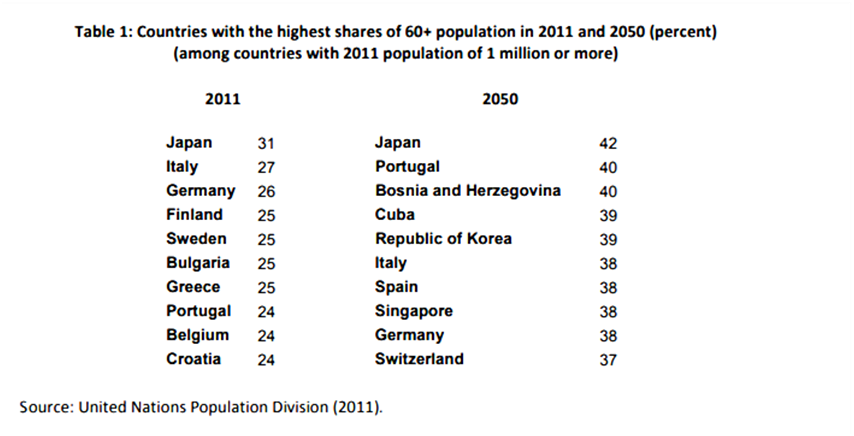
Japan is the country with the highest proportion of its population composed of older adults, with 28.2% of people being 65 or older. Other countries with large percentages of older adults include Italy, with 22.8% of its population 65 or older, and Finland, with 21.9%.
What is the youngest population in the world?
The world’s youngest countries are mostly in Africa, with Niger having the lowest median age of just 15.2 years. Having a young population can be both an opportunity and challenge for nations.
What are the opportunities of population ageing?
Firstly, ageing pushes society into making use of its underused human potential. A society cannot sustain its living standard when a rapidly growing proportion of its members are dependent on the contributions from others and when their possibilities to participate and contribute according to their abilities are limited. As people live longer, older persons have accumulated expertise, knowledge and experience to an extent that was not possible in earlier times, and can therefore contribute a lot. The provisions many countries have made to integrate older persons and their organizations into the policy making process and to encourage those who wish and can stay in their jobs longer serve as good examples. Secondly, ageing pushes society into making all service provisions and systems more efficient. A typical example is turning away from expensive institutional care to care at home. The support structures within the family and kin networks are rediscovered as important, so governmental support can be directed towards keeping up family relationships. For example, helping people who take care of their old relatives with their work schedules, or compensating them for the caring time.
How can countries deal with aging populations?
Countries are currently exploring a number of different policies to adapt to economic shifts due to aging populations. A common proposal set forth includes delaying the age of retirement, which effectively lengthens the amount of time that individuals spend working. Other possibilities include decreasing social security benefits, in cases where there are potential deficits, and increase taxes to pay for them.
Conclusion:
In conclusion, the aging of populations happens because people are living longer, having fewer babies, and societies are changing. This leads to challenges like changes in healthcare, pensions, and how the workforce functions. Policymakers have to figure out how to adjust society and the economy to deal with more older people. It’s important to understand why populations are aging and what it means to create good plans that take care of everyone and keep societies strong. Handling an aging population needs a thoughtful and complete approach to make sure everyone’s well-being is considered at every stage of life.
Numerous developed countries are dealing with older people and fewer working-age adults, leading to increased healthcare costs. This creates economic challenges, especially when a smaller group of people has to support social safety net expenses. Countries with aging populations are looking for ways to adjust to these changes and other economic shifts.In the last 45 years, Europe had more working-age people compared to children and older individuals, which was good for society. But now, things are changing as there are fewer young people entering the workforce. The systems we set up for things like work, healthcare, and support won’t work well anymore. We need to rethink and organize these systems. It’s also a challenge to make sure everyone, regardless of age, feels included in society and has opportunities to participate. Making aging a key consideration in all policies is important to ensure that we don’t forget or overlook the needs of older individuals.
 Geo-Synthesis